
The Solar Array Sizing Sweet Spot
When it comes to sizing your solar array, many factors are taken into account such as any restrictions your utility may have in place for solar array offset requirements, inverter size, module output, average sun exposure in your geographic area, change of seasons, and more. One question we often receive in our support department is, Why is my inverter kW rating smaller than the kW capability of my solar array? In other words, you may have a 5 kW inverter paired with a 6.5 kW solar array.
While it may seem like your array is producing more energy than your inverter can accept, this is not an engineering mistake. It may seem like you are trimming off 1.5 kW of solar production due to an undersized inverter, this difference in kW rating is actually benefiting the solar owner and providing the optimal DC to AC conversion ratio of 1.3 for Midwestern solar owners. Professional solar designers, renewable energy analysts, and solar equipment manufacturers have done the math and the results reveal a greater number of kilowatts are captured and inverted (DC to AC) by the array. This design practice is called Inverter Clipping.
What is inverter clipping?

You may have heard or seen the term “inverter clipping” and immediately think your array is “clipping” off free solar energy which could be consumed by your home or business or banked for net-metering credits. Inverter clipping happens when your solar array “clips” its energy production capabilities and produces more energy than your inverter can accept.
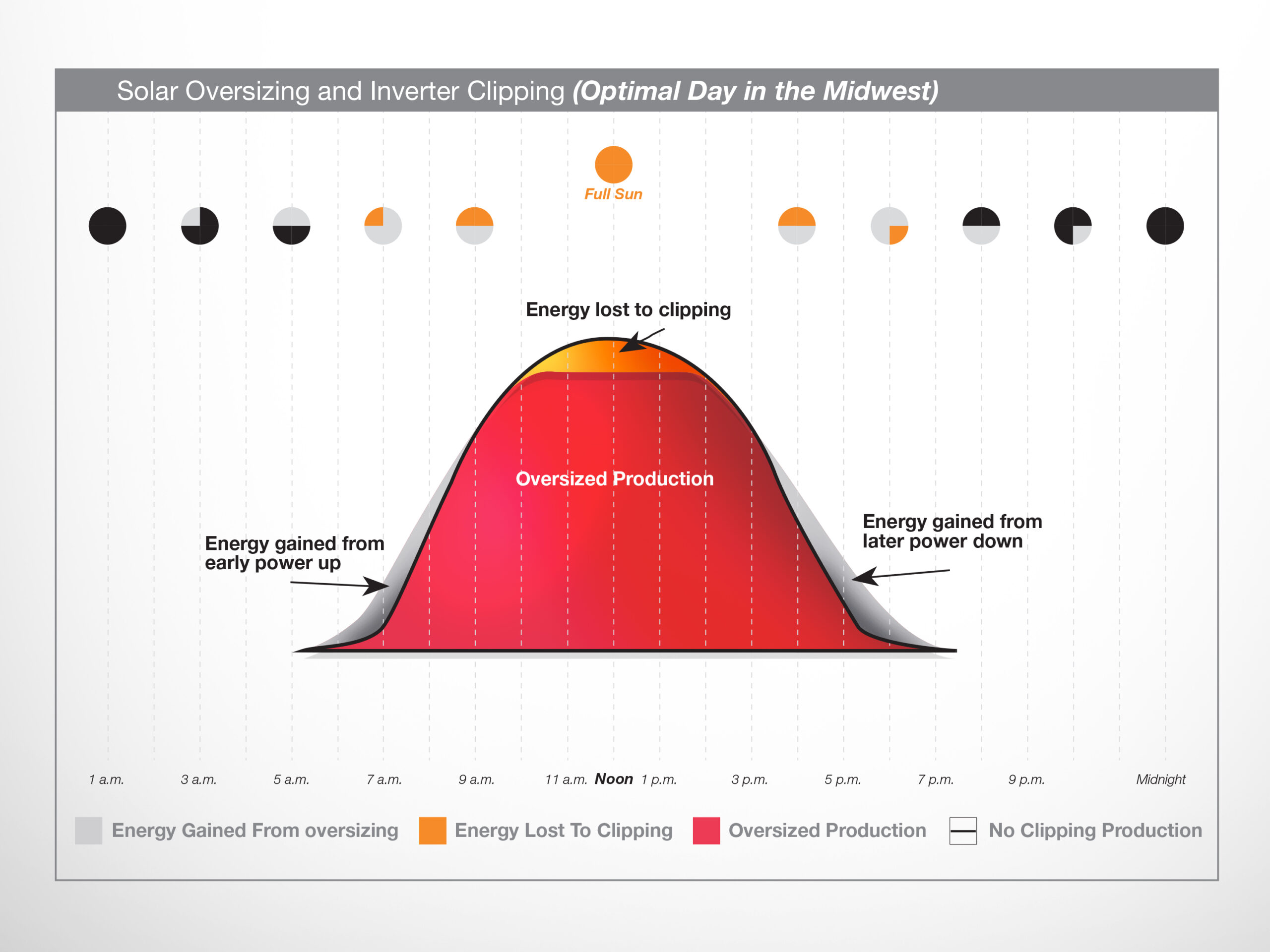
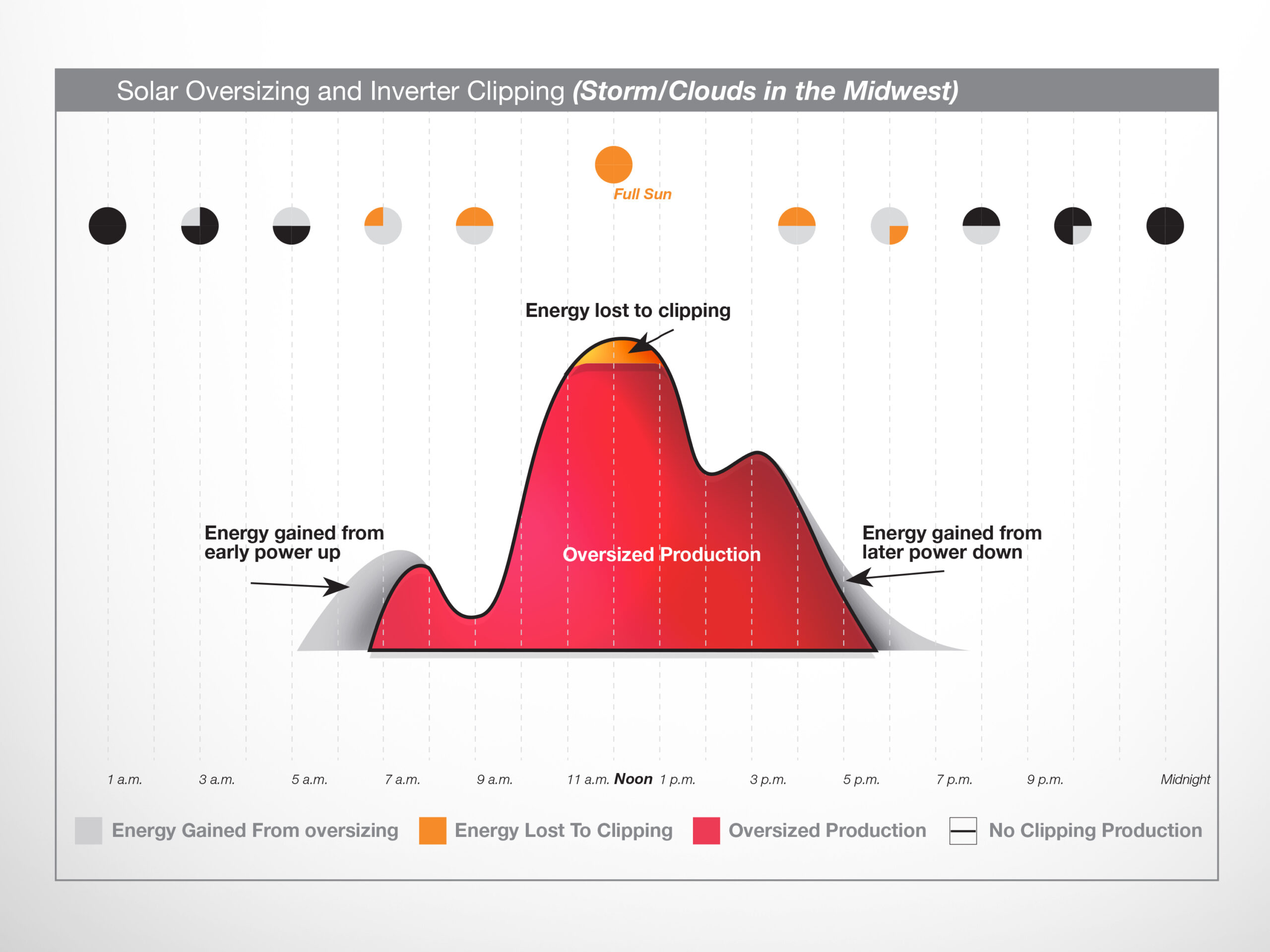
In this example, the array peaks at 6.5 kW, and the inverter can only accept 5 kW. The excess energy your array produces (1.5 kW) is then lost and never inverted to be consumed. While this seems like a waste of energy, what is misleading is the fact your array has the potential to produce more energy than it otherwise would if your inverter and solar array were identical in kW size. This is especially true in the Midwest when sunshine, bad weather days, and seasonal changes are not as predictable.
How does inverter clipping work?
The first thing to understand is how your inverter works. Inverters require a minimum voltage from the solar modules to activate and begin to do their job of inverting DC electricity (provided by the solar modules) into AC electricity (for use in the home or business). Once activated, the inverter continues to work until the array is no longer receiving the minimum voltage required to keep it running.
On a typical Midwest summer day, a 5kW inverter will awaken earlier in the morning (perhaps 6:00 am) and continue operation until evening (perhaps 9:00 pm) because the larger array is producing the required voltage needed to begin and maintain the process throughout the day. (NOTE: A higher proportion of DC to AC ratio will provide more voltage potential to activate and sustain the inverter.)
In comparison, a larger inverter may awaken (perhaps 8:00 am) and be operational for fewer hours in the evening (perhaps 7:00 pm). The larger inverter requires greater DC voltage to become and remain operational throughout the morning and evening hours. The result in this example explains why the smaller inverter gained a difference of 4 hours more of energy production. (NOTE: A larger solar array has the capability to continually feed the necessary voltage required by a smaller inverter versus a larger inverter when weather patterns change, as seen in the Midwest.)
Why is inverter clipping effective in the Midwest?
Multiply this scenario across 365 days, and you create a bell curve (see graph) that generates more useful DC to AC electricity in a ratio of 1:3 (6.5 kW array with 5 kW inverter) than if your system was sized 1:1 (6.5 kW array with 6.5 kW inverter). While you “lose” (or clip) the power you are producing at the peak time of the day – full sun, you will gain valuable production hours during the early and late portions of the day. Thus, your solar array and inverter are optimized to provide you with the greatest amount of clean, renewable energy production for any season.
(Note: Inverter clipping is a practice designed to provide optimal DC to AC solar production based on the latitudinal changes throughout the seasons in the Midwest. Areas in the country which receive more sunlight hours and maintain a stable annual weather pattern may pair the capabilities of a solar array and inverter differently.)
Additional Resources
https://www.solaredge.com/sites/default/files/inverter_dc_oversizing_guide.pdf
https://www.sma-sunny.com/en/7-reasons-why-you-should-oversize-your-pv-array-2/

If you have any questions regarding solar array sizing, inverter clipping, or going solar, contact us to begin your solar journey or complete our online Free Solar Analysis form.