
Solar Racking 101
When a solar owner thinks about their system, racking is unlikely to be among the first components of the array to come to mind. It also accounts for only a small portion of the total solar installation costs. The racking is, however, an unheralded yet vital part of any solar installation serving as the primary workhorse in securing the panels against forces of Mother Nature.
What is Solar Racking?
Solar racking is a term for the components used to attach solar panels safely and securely to buildings or the ground. Racking is usually made from aluminum, which is lightweight, strong, easy to work with, and unlikely to rust even under extreme conditions. What type of racking is right for you is largely determined by the specifics of your solar array and the location where the panels will be mounted.
Types of Solar Racking
 Roof Racking
 Roof Racking
Most roof racking begins with securing L-shaped “feet” with bolts running through the roof and into the rafters. The feet are laid out in rows corresponding to where the top and bottom of the solar panels will be. Flashing mounts, which include an aluminum rectangle base and are inserted underneath the shingles with a bolt, are sometimes used instead of feet. They are used for asphalt roof mounted systems to reduce the number of roof penetrations when possible. However, the location the solar array requires and the placement of rafters can prevent their use. Mounts or feet are attached to a roof with multiple bolts, typically 2-4, through the roofing materials. For standing seam metal roofs, the feet mount directly on the roof by attaching them to the seams. For metal roofs with existing bolts, bolts will be removed where necessary. The solar racking will then use the same holes.
Long aluminum tracks called rails are then attached to the feet. It is onto these rails that the solar panels are clamped, with the modules sitting directly on the rails. Most installers will use mid and end clamps for maximum security. Mid-clamps sit between modules, while end-clamps sit at the ends of an array. Because the rails are elevated off the roof by the feet, they leave a few inch gap to run the necessary wiring for increased safety, ventilation, debris and snow shedding and better aesthetics.
Ground Racking
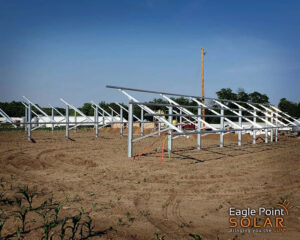 For ground-mounted systems, there is no roof to use a starting structure to build from. The solar energy system therefore must be designed and engineered to incorporate the necessary structural support. The supports are the connections between the ground and the array. At Eagle Point Solar, we use galvanized steel I-beams, which we drive into the ground. We then attach an aluminum strong-back to the I-beam, with a strut running between the two for support. Once the supports are in place, rails are then attached to the top. This style of system allows for the option to tilt the panels to achieve optimal production. The rails run horizontally with the solar modules clamped at the top and the bottom to the rails below them. Most installers will use mid and end clamps for maximum security, just like for roof arrays.
While you may not need to know the ins and outs of solar racking, it is important to know if your installer chooses quality racking materials. Solar modules are designed to last for decades. Therefore, you want your racking to last just as long and hold the panels securely in place.
Check out the video links below of a ground array being built using tie lapse or our PD10 pounding a large steel I-beam into the ground.
Pounding Steel I-Beam

Want to Learn More?
If you want to find out more information about solar arrays, along with government incentives, utility metering procedures and more, visit our blog.
If you are interested in adding solar power to your home or business, contact us to set up a free solar analysis.