
Questions To Ask A Solar Company
The decision to install your own solar energy system should not be an impulse purchase. Plan to set aside time to research companies, prepare great questions, establish your energy goals, determine financing and learn the basics of how these systems work. Selecting a qualified solar company you trust is going to be key to making a smooth and pleasant transition to renewable and sustainable solar energy. In this article, we have compiled a list of important questions to ask solar companies who you may be considering while investigating the financial and environmental benefits of owning your own solar array.
What do your clients say about you? How much of your business is referrals?
Consumers are increasingly using online reviews to help them learn about companies and the products and services those companies offer. Google Reviews is the dominant leader in offering unbiased and verified reviews. Want to learn more about Eagle Point Solar and what our clients are saying? Read our Google Reviews.
Asking the solar companies you are considering for referrals helps you understand what the company’s reputation is like in the local area. Your friends, neighbors, and community business owners would not refer others if they did not have a good experience. At Eagle Point Solar, a large majority of our clients come from referrals or word of mouth in the communities we serve. Our Referral Rewards Program was developed to support our growing base of referrals and provides a financial benefit for those helping to share in our success, regardless if you are a solar owner or not.
How long have you been in business? How many installations have you completed?
In the solar industry, experience matters. Every home, business, and solar project is different and unique in some way or another. Companies that are dedicated to providing turnkey solar solutions with a decade or more of experience are likely to have thousands of solar installations completed of all sizes and scopes. This longevity and broad pool of completed projects ensures you are partnering with a solar company with a trusted process and proven results. Read more about Eagle Point Solar’s history here.
Do you have a physical office, locally?
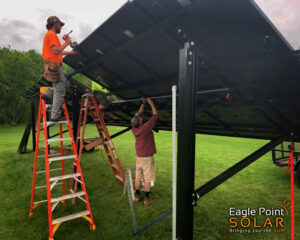
Asking about a solar company’s physical location can provide you with a better understanding of their geographic footprint, commitment to the area, logistics and distribution capabilities, employee base, future service, and support capabilities, and much more. There are a wide variety of solar companies of varying sizes. Some operate as small, hyper-local companies often with a team of 3-10 employees. Others, like Eagle Point Solar, are regional. These firms are dedicated to serving a specific geographic area often within a few hours of their distribution hubs and remote office locations. Due to their increased footprint, regional firms often have an employee base of 75-150 employees. Their purchasing power allows these firms to hire expert designers, engineers, electricians, and NABCEP certified solar energy installation experts. Furthermore, regional firms are often better equipped to manage all aspects of going solar such as incentive and manufacturer warranty paperwork, building permits, and utility interconnection agreements. Additional advantages of a regional firm are often their lower equipment procurement costs, access to premium solar technologies and ability to locally service and support your purchase decades after it is built.
Lastly, there are national solar companies. These firms often cover a large portion of the U.S. and are devoted to servicing larger metropolitan areas and expansive investor-owned utility-scale solar farms. These large firms typically only offer virtual meetings or calls since their sales workforce is typically out-of-state. While these firms can certainly provide quality equipment and knowledgeable staff, their size and headquarter location is a great indicator of whether they will be sub-contracting the installation to someone else. See a map of Eagle Point Solar’s projects and areas of coverage.
Will you sub-contract out any part of my project?
Asking this question with a potential solar company provides you with insights into their level of expertise, scope of capabilities, and commitment to client satisfaction. In most cases, sub-contracting provides limited control over your project and can result in delays, miscommunication, poor workmanship, or costly overruns. While sub-contracting is often a common practice in the construction industry, it is key to be aware of this practice and ensure if subcontractors are being used in your project they are equally as qualified to perform the work. Selecting a solar company with a dedicated team of certified designers, engineers, electricians, construction and office staff is one way to be certain your project is in good hands. At Eagle Point Solar, we are dedicated to the design, engineering, and installation of solar energy solutions and nothing else.
What makes individuals at your company qualified to design, engineer and install solar?
This is a great question that can help you narrow your selection of solar companies to consider partnering with. Ask about any solar industry certifications they may have. The North American Board of Certified Energy Practitioners (NABCEP) provides a certification that signifies the expertise of the individual holding the certification. Consider asking about industry awards such as Solar Power World’s Top U.S. Solar Contractor selection and any advanced education which may highlight the expertise of the team(s). Learn more about Eagle Point Solar’s experience.
Will you visit my site before I sign a contract?
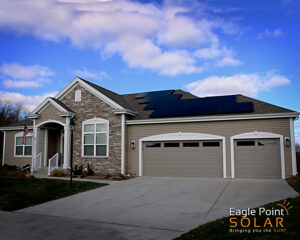
There is a sea of advanced software tools available to aid in the technical aspects of designing and engineering a solar array to meet your energy goals. However, there is no substitute for having a person visit your site and learn more about your goals, evaluate current electrical supply equipment, and provide an overall feasibility inspection of the site. A visual site inspection helps to provide information that software cannot, including the condition of the roof, current shade and growth of trees, subtle differences in pitch or elevation, and more. This crucial step allows the solar company to verify the site is capable of meeting your energy goals with the use of solar. Additionally, it helps to minimize unforeseen construction problems which could potentially cause a project to increase in price. The site inspection process may occur pre or post contract depending on the type of sales process the solar company follows. However, be leery of solar companies who skip or minimize the site inspection prior to construction. Read more about Eagle Point Solar’s sales process here.
Will you be handling all the paperwork, obtain necessary approvals and schedule inspections?
Depending upon where you live and your utility policy, there could be a substantial amount of paperwork to complete before your solar array becomes reality. This documentation work pertains to local building permits, utility interconnection agreements, local, state, or federal incentive programs, grant submissions, manufacturer warranties, and more. Understanding what paperwork the installer handles and what is your responsibility is critical to a smooth solar installation. In most cases, a reputable installer will complete and submit the necessary paperwork for you. Learn more about Eagle Point Solar’s core focus and values.
What are the warranties?
There are three kinds of warranties to look for when purchasing solar: performance warranty, product warranty, and workmanship warranty. Performance warranties are from the equipment manufacturers and guarantee your system is rated to generate a certain level of output after a specified number of years. Product warranties cover replacement and/or repairs to the components of your solar energy system. Finally, workmanship warranties are from the installer and will generally cover labor and equipment for a specified amount of time following the installation.
What type of financing options do you offer? Will I own or lease the system?
There are a variety of financing options available on the market such as residential and commercial loans, home equity loans, Power Purchase Agreements (PPAs), operating leases, and more. Some solar installers offer multiple financing options from various local banking institutions while other installers may offer only one. It is important to know what financing mechanism you will be using. Will you be leasing the panels for a period of time or owning your system at the end of a term? Both, leasing and financing with a loan, provide the option to swap your utility’s monthly electric bill for a payment towards your solar array. Often these payments are less than your current electric bill, helping you to save money from day one.

If you have any questions about the solar process, contact Eagle Point Solar today.