
Is My Home Suitable For Solar Panels?
Saving money on your electric bill is the primary reason people go solar. However, determining the suitability of your property for solar, is far more complex than using an online app . For many trying to answer the question whether solar is suitable for your home, you may have read about a “Sun Number Score” from Sun Number, or “Sunroof Score” created by Google’s Project Sunroof. While calculating your Sun Number or Sunroof Number is informative, it doesn’t necessarily calculate all the factors which should be considered in making an educated decision about solar suitability.
How Much Sunlight Does Your Roof Receive?
Roof orientation is a key factor in the amount of production generated from a solar array. In the midwest, a south-facing roof is best for capturing the most amount of sunlight. Other roof directions such as east and west are also suitable for generating vast amounts of solar energy production.
In combination with roof placement and analyzing decades of local weather data, a trained energy analyst can further provide a more accurate prediction of how much production a solar array will produce in the desired location identified. Rainy, cloudy, and snowy days should also be calculated into the predictions and based off of the local historical information. When these additional factors are calculated into solar production and results are reported, the midwest continues to be a beneficial area for solar energy generation.
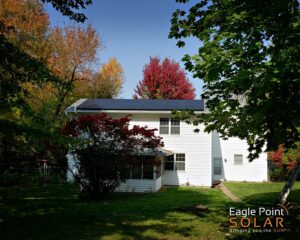 When choosing where the array will be placed it is important to select a surface which will receive the most direct sunlight between 9:00 am – 3:00 pm. At Eagle Point Solar, our experienced design and engineering team will provide you with the best options based off your geographical footprint and areas of consideration for the array to be built to achieve optimum production.
Trees are a common barrier preventing many people from considering going solar. Shading can have a huge impact on the viability of a solar project but should not be a determining factor in choosing not to consider producing your own affordable, renewable energy. While any amount of shade directly influences production, a small amount may not impact your production as much as you think. Many solar owners can still yield a good return on their solar investment even if shading is a concern.
The combination of using local weather data and human expertise coupled with understanding the current property through conversations, current photos or and an onsite assessment can have profound impacts on the production capabilities and rate of return of a proposed solar array and further provide for more accurate data than online solar tools currently populating across the internet.
What Does Your Roof or Yard Space Look Like?
If your roof shingles are in need of replacement, may want to consider replacing your shingles before going solar. Other option is to plan ahead for any additional cost for having the system removed and reinstalled should your roof repairs be further into the future. The roof material additionally plays a significant part in the design, engineering and installation of roof-top solar. Some roof types are more difficult and potentially problematic to install a solar array on, including wood shake tiles, clay tiles, or slate tiles.
The available space on your roof for a roof-mounted solar array is also a factor on determining your overall production capabilities. A single solar panel on average is 3×5 feet and an average-sized home could roughly need 20-30 panels, while a home which is all electric, has a car charger, or pool/hot tub could need 30 panels or more. Learn more here about determining the size of a solar array: https://eaglepointsolar.com/how-many-solar-panels-will-i-need/
When looking at your roof consider where vents, skylights, or satellites are located. These obstructions can greatly limit the amount of available space for solar panels. If your roof does have some limiting factors, no worries, solar can be designed using the space available. It’s important to note, a solar array does not have to offset 100% of your electric usage to provide a positive return on the investment.
Lastly, if you’re limited on roof space, a ground array may be a great option and allow for more flexibility to achieve greater production results. Working directly with an experienced solar design engineer and solar energy consultant can further provide you with design options and recommendations to. improve the solar suitability of your property.
What Does Your Electricity Bill Look Like?

Knowing how much energy you purchase from your utility helps to gauge how much you will save each month when you begin creating your own clean, renewable electricity from your solar array. Typically, if your monthly electric bill is $75 or greater, than you are most likely a good candidate for considering solar as an affordable alternative to lowering your electric bill.
Examining your electric bill also helps to identify your utility company to help answer the question of “What is their solar policy?” Different utilities follow different rules when it comes to installing solar and sending excess energy back to the grid.
While one utility may provide a kilowatt of credit for every kilowatt received, another utility may provide a monetary value for every kilowatt received. Learn more about net metering here: https://eaglepointsolar.com/utility-net-metering-vs-utility-net-billing/. Other utilities may follow a time-of-day or time-of-use billing program where the cost of energy changes throughout the day. Understanding the solar policy of your utility is imperative to whether or not solar is suitable for your situation. It’s important to note, advances in storage battery technology has greatly expanded the viability and rate of return for solar owners even if the utility policy is not as favorable as another.
If you have questions or would like to explore the solar suitability of your home, farm or business give us a call or begin here with our free Free Solar Analysis estimate.

Embrace Solar, Embrace Savings
When you choose to adorn your property with solar panels, you’re not just embracing a greener future; you’re making a savvy financial move. Bid farewell to those high electricity bills and say hello to lasting energy savings.
Our Eagle Point Solar team of experts is committed to designing and building a solar energy solution tailored to meet your home’s distinctive requirements. From the first consultation to the final installation, we’re right there by your side, ensuring every step is smooth and seamless.