
Iowa City’s Trusted Solar Energy Company
Why Make Eagle Point Your Solar Panel Installer in Iowa City
Our People are Trusted
At Eagle Point Solar, we don't believe in making unrealistic promises. Instead, we provide you with the data you need to make an informed decision about solar, including how much power you are likely to generate and projections on how long it will take for the array to pay for itself.
Our Process is Tested
We have extensive experience installing solar arrays large and small in Iowa City and throughout Iowa. That experience means we know all of the relevant permitting requirements and we handle all the paperwork required by the utility.
Our Results are Proven
Eagle Point Solar has been named one of Solar Power World’s Top Solar Contractors and Solar + Storage Contractors in the U.S., and systems we installed have produced proven results for residential, commercial, agricultural, municipal, academic and nonprofit customers. Large or small, our arrays provide the power you need.
Projects We've Completed in the Iowa City Area

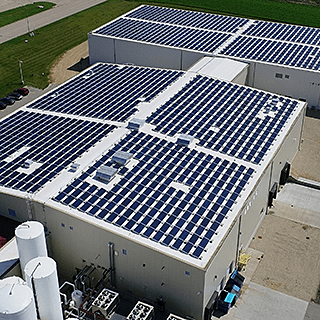
City of Cedar Rapids Water Department

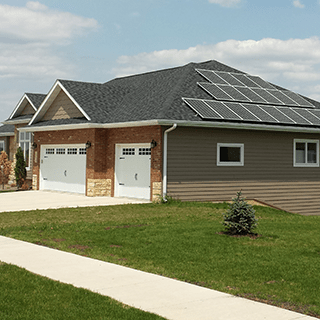
Wellington Heights Community Church

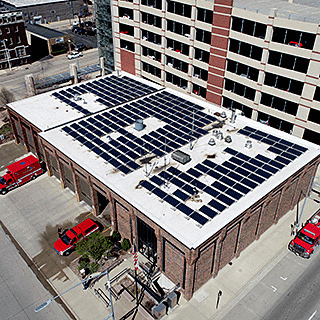
Wired Production Group
Frequently Asked Questions About Solar Installation
The utility will notify the client and Eagle Point Solar. When Eagle Point Solar is notified, we will reach out to the client to tell them how to turn the array on or schedule a staff member to come turn it on. Eagle Point Solar will monitor the array to ensure it is producing optimally and establish online monitoring access for the client.
For more information, read our blog article Going Solar: What Happens After You Have Signed the Solar Contract?
Capturing the power of the sun using solar technology helps reduce greenhouse gas emissions (https://nature.berkeley.edu/classes/es196/projects/2013final/ArifM_2013.pdf), which contributes to climate change, and also results in fewer air pollutants like sulfur dioxide and particulate matter, which can cause health problems.
For more information, read our blog article You Can Reduce Your Carbon Footprint with Solar.
A solar system will reduce your electric bill and start to pay it’s self off immediately. Even if you move before your solar investment is completely paid off studies show the remaining value will likely be returned upon the sale of your property. In addition, it can potentially help your property sell faster offering a guaranteed lower electric bill. Warranties are transferable one time to a new owner. Read about it here: New York Times article (https://www.nytimes.com/2015/02/22/realestate/solar-panels-and-home-values.html?_r=0) or (https://news.energysage.com/home-solar-power-increase-property-values-across-us/)
For more information, read our blog article Does A Solar Energy System Affect Property Value?
Eagle Point Solar offers an innovative, turn-key solar energy solution offered through a comprehensive process which takes your system purchase from concept to commissioning. There is no faster, easier way to obtain a cost-saving, environmentally friendly solar energy system for your home or facility. Learn more about the Eagle Point Solar Journey process.
For more information, read our blog article Going Solar: What Happens After You Have Signed the Solar Contract?
From day one, solar power offsets some or all of your electricity purchases from your utility and therefore reduces your electric bills. Since there are very few, if any, on-going costs, you also lock in the solar portion of your electricity costs which is a great hedge against inflation and makes budgeting your utility costs a breeze.
You will fully recoup the cost of the solar energy system long before the end of its useful life. Since most components are warranted for up to 25-years and last for 40+ years, you will be reaping the financial and environmental rewards for decades to come.
Additionally, solar will improve public perception as you, and/or your business are demonstrating your commitment to a healthier planet. Environmentally conscious residents and businesses are viewed as good neighbors in any community.
For more information, read our blog article Installing Solar: Harnessing Solar Energy and the Benefits.
The solar panel contains several individual cells which are made largely of two layers of silicon. By design, there is an electronic imbalance between the two layers and when the sun’s photons bombard the cell it knocks the electrons loose. The electrons then “bounce” from the top layer to the bottom layer creating energy. These bouncing electrons are captured as electricity by metal contacts in the panel.
Since the electricity created inside the panel is direct current (DC), it is necessary to push the current through an inverter which creates alternating current (AC). Once converted, this electricity is then routed to your electrical outlets for your use. Watch this short video to learn more about the specifics of a solar cell: https://www.youtube.com/watch?v=xKxrkht7CpY
While the equipment does have workmanship and production warranties, they do not cover theft or damage from external sources. However, most homeowner insurance policies will cover your solar system. Check with your insurance provider for more information on your policy.
For more information, read our blog article A Guide to Solar Panel Warranties.
Currently, we do not offer design, installation or equipment purchasing for lake or pond aerator systems. However, below are two spec sheets for lake/pond aerator systems and a link to a local firm in Sparta, Wisconsin who we have recommended for these types of projects: https://www.ussolarmounts.us/products/brushless-solar-lake-aerators/
The biggest difference from net metering is net billing customers receive an avoided cost price per kilowatt-hour from their utility versus a credit at retail cost. The avoided cost price which the utility pays for your solar overproduction (per kilowatt-hour) is often equal to or less than the wholesale price which the utility pays for purchasing energy from other energy power plants. In otherwards, it is the “avoided costs” the utility does not have to pay to produce or purchase the same amount of power. When excess solar energy during the month is sent to the utility, each kilowatt-hour is calculated and credited at the avoided cost rate to the customer’s monthly bill. Rural Electric Co-ops and Municipal utilities typically offer net billing to their customers because they are not required to follow IOU policies for net metering. Based on your utility, net metering credits will typically zero out (or true-up) once a year. Credits are stored and used as needed during the month. Any excess credits are carried over month by month until the end of the true-up month.
For more information, read our blog article Utility Net Metering vs. Utility Net Billing.