
Rising Energy Costs Hit Consumers with Substantial Electric Rate Increases
 Electricity prices across the Midwest are rising fast — and they’re not slowing down anytime soon. If you’ve been on the fence about switching to solar, the time to act is now. From increasing wholesale prices to major utility rate hikes and shifting energy demands, several trends are converging to make solar not just a smart choice but a financially urgent one as well.
Here’s what’s happening, and why solar is your best defense against rising energy bills now and into the future.
New Data Centers Will Spike Demand

Massive new data centers, some projected to use as much energy as entire cities, are adding even more pressure on the grid. According to Wisconsin, Rep. David Steffen, a new Microsoft data center in Mount Pleasant would use the same amount of energy as the city of Madison, and the Port Washington data center would use the same amount of power as the entire city of Los Angeles.6
Along with data centers, manufacturing is expanding across the U.S. due to tariffs and new incentives in the One Big Beautiful Bill. AP News observed that Johnson & Johnson is investing $55 billion in the U.S. over the next 4 years, which will include 4 new manufacturing plants.7 The Telegraph highlighted that Wieland Rolled Products is investing $500 million to increase production and retain 800 jobs in Illinois.8
While great for the U.S. economy, these, along with other major manufacturing investments, are creating a need for utilities to update aging infrastructure to meet the growing demand. Utility Dive emphasized that investor-owned U.S. electric utilities will invest more than $1.1 trillion in the 2025–2029 period as the sector rushes to meet growing power demand.9
New facilities and upgrades are coming online quickly, so as the energy demand increases, the current supply versus the demand for available energy will cause the market to soar. Utilities will need to meet the demand of their customer base and will be forced to buy energy at much higher rates.
Without major changes, analysts predict that the average American household energy bill could increase between 25% and 70% in the next decade.6
Energy Stats worth noting for consumers
Due to major energy policy changes and increasing demand, electricity and gas prices in Iowa, Wisconsin and Illinois are climbing quickly, with no relief in sight.
- Iowans are forecast to pay $350 more per year for energy by 2035, according to The Des Moines Register1.
- Wholesale electricity prices are projected to rise 48% by 2035 in Iowa, reported in Energy Innovation Policy & Technology2.
- Data from the Illinois Citizens Utility Board shows that capacity auction prices, which determine a major part of your electric bill, surged to 830% year-over-year for 2025-2026 and recently set another record high of $329.17 per MW-day for 2026-2027.3
- Illinois electric customers are already feeling the impact, with ComEd and Ameren raising rates 53% and 47%, respectively, as stated in PR Newswire4.
- In Wisconsin, electric utilities are seeking double-digit increases over the next two years, and WisPolitics says the state now has the second-highest electricity rates in the Midwest.5
Solar Incentives Are Ending: What This Means for You
 In early July, President Trump signed the One Big Beautiful Bill Act into law. Among its many provisions, the bill makes substantial changes to federal solar tax incentives* — and introduces hard deadlines that every homeowner and business should be aware of:
- The 30% Residential Federal Tax Credit* will end on December 31, 2025.
(At Eagle Point Solar, we are working diligently to ensure all projects with signed contracts on or before September 30, 2025, are built and operational before this deadline.) - The 30% Commercial and Agricultural Federal Tax Credit* will end on December 31, 2027.
- The bill restores 100% bonus depreciation on commercial solar projects — a major win for businesses looking to offset upfront costs.
You can find more details here: Solar Tax Credits and Incentives.
Shield Yourself — Why Solar is the Solution
Going solar is no longer just an eco-conscious decision — it’s a financially strategic one. With utility prices climbing and federal tax credits* winding down, solar offers:
- Financial freedom from utility rate hikes.
- Immediate and consistent savings.
- Greater energy independence.
- Significant tax advantages — but only for a limited time.
Solar owners have the advantage of producing clean, affordable electricity from their personal solar array, and they can use that power immediately as it’s produced. This reduces the need to consistently purchase power from the grid and helps to offset the amount of power purchased each day or month from the utility company.
This generally creates huge cost savings for the consumer, as the monthly payments for solar are typically far less than paying for grid electricity, according to Solar.com.10
Additionally, the per kilowatt rate of a solar array is a fixed cost with a defined payback period. The per kilowatt rate from a utility company goes up nearly every year and is out of the consumer’s control.
A note from Solar.com: Grid electricity prices continue to rise over time. Typically, utility rates rise at an average rate of 3% per year. However, in recent years we’ve seen double-digit rate increases in a single year, and we’re not exactly expecting prices to go back down in 2025. Going solar not only lowers your electricity costs, it stabilizes them for 25 years and shields you from utility rate hikes.10
The Window of Opportunity Is Closing
Between record-high capacity prices, steep utility rate increases, and the hard deadlines set by the One Big Beautiful Bill, waiting to go solar could cost you thousands — in both rising energy bills and missed incentives.
Now is the time to take control of your energy future.
Contact us today for a free solar analysis and secure your project timeline before these incentives expire.
Don’t Wait — Timelines Matter
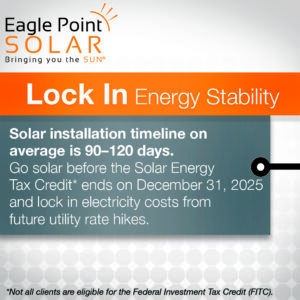
On average, a residential solar installation takes 90 to 120 days from contract to completion.
Waiting too long could mean missing the deadline. For a typical $25,000 system, missing the credit would cost you $7,500 in lost savings.
To qualify for the 30% Federal Tax Credit*, your solar system must be placed in service by December 31, 2025 — not just under contract.
Start now to lock in your build date and avoid unnecessary delays.
Sources
2 https://energyinnovation.org/wp-content/uploads/OBBBA-impacts-on-Iowa.pdf
6 https://www.thecentersquare.com/wisconsin/article_c85cb458-16b7-4546-b28c-9519fafed1e1.html
7 https://apnews.com/article/johnson-apple-north-carolina-trump-3afc1b68dd0ba09242b5d56a0e2eb86d
10 https://www.solar.com/learn/how-much-do-solar-panels-save/
*Consult with your tax professional to learn more about how you can take advantage of tax credits and incentives. Not all clients are eligible for the Federal Investment Tax Credit (FITC).

Lock In Your Solar Build Date to Save
With the 30% Residential Federal Tax Credit* ending on December 31, 2025, it is important to get your solar build date on the calendar as soon as possible to achieve the maximum possible savings with solar.
That deadline is for the solar to be built and operational, which means you can’t sign a contract right before Christmas and expect to take advantage of the tax credit. At Eagle Point Solar, our aim is to ensure all projects with signed contracts on or before September 30, 2025, are built and operational before this deadline.
To find out more about how much solar can save, contact us for a free solar analysis today. Delaying could mean missing out on substantial savings.