
Why Solar is the New Crop
Farmers are no strangers to high electric costs given the number of buildings and equipment required to run a successful farming operation. Whether it is ventilation fans, milkers, grain dryers, feeders, stockyard flood lights or any of the other numerous energy-intensive tools and devices helping to aid in the daily workload. Today, many farmers who planted the seed in fostering solar technology are reaping the benefits of this technology to cushion tight margins. Laggards are now seeing the financial and environmental benefits provided to those who adopted solar as the new crop within the agricultural industry.
Farmers who have chosen to go solar have protected their bottom-line from increased utility electricity rates year-over-year and benefited from incentives in the form of tax credits, accelerated depreciation and renewable energy grants. This foresight has allowed many farmers the opportunity to experience immediate and continual returns on their investment. Improvement of cash flow has been a direct result of lowering the cost of energy for their farming operation(s). Fast-forward, these farmers now harvest the rewards of a stabilized energy solution designed and built to provide free, clean, renewable and sustainable electricity from the sun.
Solar is the new crop because of the…
Affordability & Return on Investment
The desire to cultivate the power of the sun requires assurance in reliable equipment and a proof positive return on investment. Modern advances in solar technology during the past decade have greatly expanded the output capabilities of solar while significantly reducing procurement costs. Affordability and yield, coupled with local, state and federal incentives, continues to provide farmers with an alternative crop positioned to provide operators with a great return on their investment.
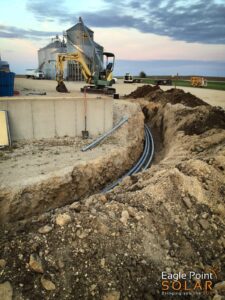 As long as the sun shines, a professionally designed, engineered and installed solar array will continue to produce electricity to curve the on-going and demanding energy needs of the operation. This circle of life starts over every 24 hours, 365 days a year, year-over-year for generations.
Available incentives:
• Federal Investment Tax Credit (ITC)
• State-specific incentives
• MACRS depreciation
• USDA REAP grants (04/01/2026 Update – The Rural Energy for America Program will not be making further grant awards for the fiscal year. Visit the program website for full details.)
• Local programs
Predictability
While utility rates will inevitably increase operating costs, operators producing electricity from solar will enjoy producing their energy directly from the sun. This trade-off provides low-cost, manageable and consistent results for easy budgeting. In addition, because a vast majority of manufacturers provide 20-25-year warranties, farmers gain peace-of-mind knowing their investment is protected, built to last, and engineered to produce results for decades.
Unused Space
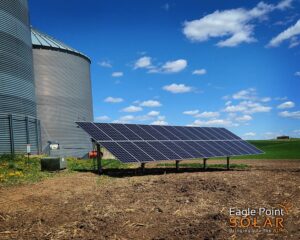 Farms are great candidates for either ground or roof solar arrays. Solar can make use of an area which is not being utilized for anything else. Agricultural businesses typically have several large buildings with simple roof lines and minimal obstructions for roof array consideration. Ground arrays are an option in a pasture, along a fence line, or installed on a hillside difficult to cultivate.
Additionally, a solar array will not affect farm animals and can provide a space of shade or protection from the elements during the year. Solar panels do not generate heat, make noise, or have any moving parts. Essentially, they can be incorporated into a farming operation with minimal disruption or on-going maintenance.
The Next Generation
 If your farm is a family-owned operation, a solar energy system will benefit you as well as future generations. There is certainly no shortage of farming equipment you can purchase to take advantage of tax depreciation; however, excess equipment requires labor to operate and labor to maintain. Once installed, solar requires very little maintenance and continually yields a product in demand… electricity.
Additionally, solar is a low-risk investment backed by ironclad warranties in the event something does go wrong. If you’re looking for an investment designed to provide a positive return for a second or third generation of operators, solar should be part of the discussion.
In Conclusion
For many farm operators the decision to go solar makes financial and environmental sense. Solar supports the bottom line and aligns with many of the values to protect, maintain and sustain the land and farming operation for the next generation. The ability to produce clean, sustainable and renewable energy from the sun grows the independence and self-reliant nature of the operation and its stakeholders.
The future of solar participation across the Midwest continues to grow and support the operational needs of an invaluable industry we greatly depend on. If you are a farmer, or future farmer, solar is certainly a crop worthy of harvesting for many more seasons to come.

Solar is the new crop. Contact Eagle Point Solar to get started on your solar journey today.